Search · Bangla-first · Bangladesh
খোঁজ.বাংলা
Khoj Bangla — Bangladesh's second search engine
বাংলায় খুঁজুন, বাংলায় পান — search in Bangla, get answers in Bangla.
Bangladesh has had exactly one homegrown search engine. Pipilika launched at Shahjalal University of Science and Technology in April 2013 and shut down in 2021, and nothing replaced it. খোঁজ.বাংলা is the second attempt: a Bangla-first search engine on a Bangla domain name, with a verified index of Bangladeshi sites, live Bangla answers assembled from 49 open sources, and 46 free tools around the search box.
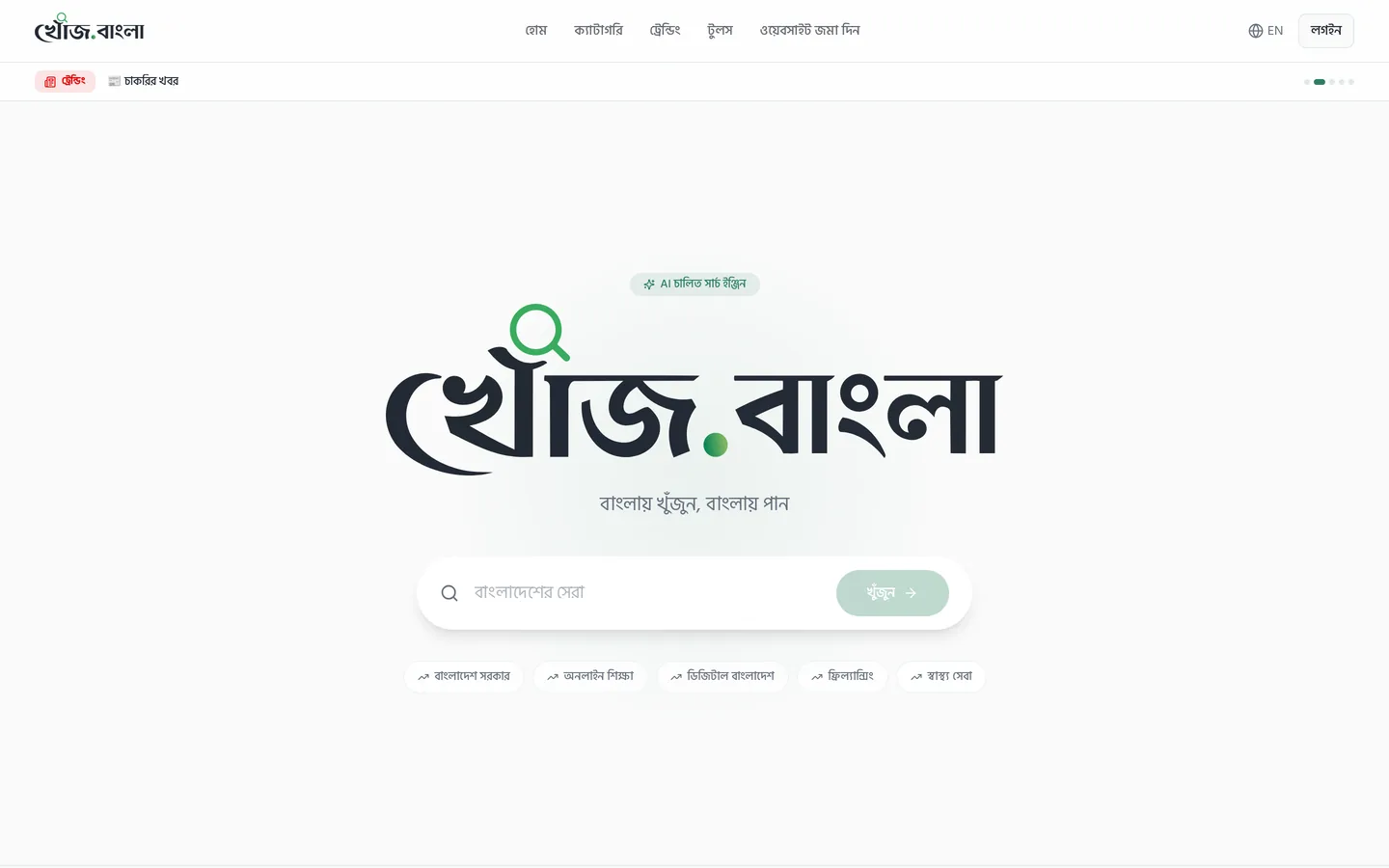
The engine as it stands today
98
Verified Bangladeshi sites
Each one confirmed reachable before it entered the index
49
Live data providers
News, weather, encyclopaedia, dictionary, currency, trends — all keyless
46
Free tools
PDF, image, AI, network, productivity and utility, in Bangla
67
Database tables
Search, crawl, ranking, caching, tools and live-data plumbing
Read from the live database and the application's own tool registry on 22 August 2026. Yes, 98 is a small index — it is a verified one, and it is stated rather than dressed up.
The first one
Bangladesh built a search engine. It has been dark since 2021.
The project that became Pipilika started in 2009 in the Computer Science and Engineering department at Shahjalal University of Science and Technology in Sylhet, begun by Md. Ruhul Amin and supervised by Professor Muhammad Zafar Iqbal. It was finished in 2013 by a team of eleven students from the department, with financing and distribution support from Grameenphone IT.
The beta launched on 13 April 2013 at a hotel in Dhaka, on four terabytes of storage, searching Bengali and English. It indexed news sites, blogs, Bengali Wikipedia and the national e-information repository, and it shipped something no foreign engine had bothered with: a Bengali dictionary and Bengali spelling correction. By 2016 it had added news, a library, shopping, and job search.
It was, for a while, the thing a Bangladeshi could point at. Then it declined, and in 2021 it went dark. The reasons given are not mysterious and are worth repeating exactly: it was a university project rather than a commercial one, so it never got the funding to become a product that paid for itself — and it was barely promoted, so most of the country it was built for never learned it existed.
Five years on, nothing has replaced it. Bangladesh — 180 million people, a language spoken by more than a quarter of a billion — has no search engine of its own. খোঁজ.বাংলা is the second attempt, and it is built with the first one's post-mortem in hand.
What the second attempt does differently
Pipilika's failure has a documented cause, and it was not technical. Treating that as a specification rather than as trivia is the entire premise of this project.
| Pipilika (2013–2021) | খোঁজ.বাংলা (2026–) | |
|---|---|---|
| Origin | University thesis project, SUST CSE | A product inside a company, with an owner |
| Funding | Grant and sponsor support; no revenue model | Funded by Rythzen; tools and ad surface built in from the start |
| Who maintains it | Students, who graduate | A standing engineering team |
| Promotion | Almost none — most people never knew it existed | Public brand, SEO, and a Bangla domain people can type |
| Address | pipilika.com — a Latin-script name | খোঁজ.বাংলা — a real Bangla IDN, plus khojdotbangla.com |
| Beyond the ten links | News, library, shopping, jobs | Live answer cards, plus 46 free tools in Bangla |
| Index today | Four terabytes, crawled | 98 verified sites, curated — a crawler is in progress |
| Stated honestly | — | The index size is published on this page, not hidden |
Pipilika's figures are from Bengali and English Wikipedia and contemporary Bangladeshi press coverage, listed in the sources below. The comparison is not a boast: on raw index size Pipilika at its peak was far ahead of where খোঁজ.বাংলা is today.
Why it is worth doing at all
A quarter of a billion speakers, under half a percent of the web
Bengali is the sixth most spoken native language on earth, with roughly 230 million native speakers and about 273 million in total. It is the official language of Bangladesh, where nearly everyone speaks it as a first language.
Bengali accounts for less than half of one percent of content on the web. English accounts for close to half of it. That gap is not a curiosity — it is the daily experience of searching in Bangla and being answered in English, or being answered in Bangla by a machine translation of an English page written for somebody else.
Meanwhile Google holds about 97% of search in Bangladesh, and Bangladesh is the most mobile-weighted internet market that has been measured — roughly 71% of web requests from the country come from a phone, the highest share in the world.
So the target is not "beat Google". The target is a narrow, real thing: when the question is Bangladeshi and the language is Bangla, return Bangladeshi sources, in Bangla, fast, on a phone. That is a winnable fight, and nobody is currently fighting it.
What makes it different
Bangla-first, not Bangla-also
Almost every "supports Bangla" claim on the web means an English product that will accept Bangla characters. These are the places where being Bangla-first changes the engineering.
A Bangla domain name
খোঁজ.বাংলা is a genuine internationalised domain in Bangladesh's own .বাংলা top-level domain, so the whole address can be typed on a Bangla keyboard. khojdotbangla.com serves the same engine for clients that still handle IDNs badly.
A hand-built Bengali analyser
PostgreSQL ships no Bengali text-search configuration, so one was written: a normaliser for Bengali text, an OR-matching query builder, and generated Bangla and English search vectors with trigram indexes behind them.
English queries, Bangla index
Indexed sites carry 231 bilingual tags, so searching "news" finds a site that only ever describes itself in Bangla. Requiring the user to guess the indexed language is how a bilingual engine quietly becomes monolingual.
Banglish, spelling and synonyms
A transliteration lexicon and a synonym table let a query typed in Latin letters, or spelled the way it sounds, still land on the right Bangla term — which is how Bangladeshis actually type.
A recovery ladder, not a dead end
A single retrieval function walks a ladder of strategies — exact, relaxed, fuzzy, rewritten — and tells the page which one it used, so the interface can say "showing results for…" instead of returning nothing.
Live answers, not just links
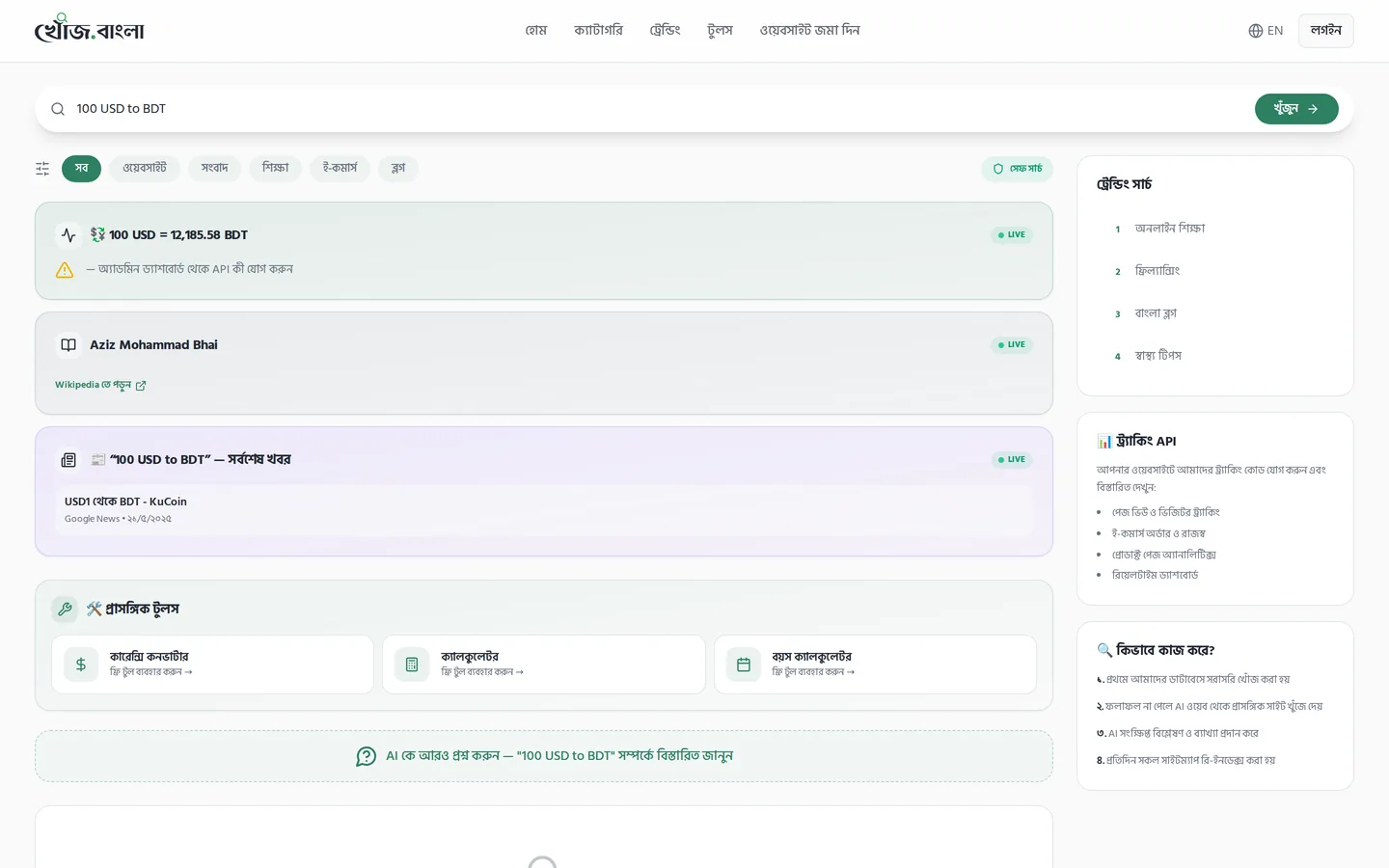
A query can return today's Bangla headlines, an encyclopaedia summary, weather, a dictionary definition, a currency conversion or a trend — assembled from open sources and cached, with a circuit breaker so one slow provider cannot stall the page.
No API keys, no gatekeepers
All 49 live-data providers are keyless and open. An earlier version depended on key-gated services and returned nothing at all when the keys were absent — the most common way a data feature dies silently.
Providers are rows, not code
Adding, reordering or disabling a data source is a database change, so behaviour is tuned without a redeploy and a misbehaving provider is switched off in seconds. Provider health is recorded, not guessed at.
Real Bangla typography
The interface is set in Hind Siliguri, self-hosted rather than fetched from a third party. Bangla rendered in a face designed for Latin script is legible but unpleasant, and unpleasant is enough to lose a user.
A verified index
Every site in the launch index was checked as genuinely reachable first, and four well-known Bangladeshi domains were rejected because they do not resolve. An engine that returns dead links teaches people not to trust it.
Owners can submit their own sites
There is a public submission route and a verification flow, so a Bangladeshi site owner can ask to be indexed rather than waiting to be discovered.
Installable and offline-aware
It ships as a progressive web app, so it installs to a phone home screen like any other app — in a market where the phone is the primary computer.
The product
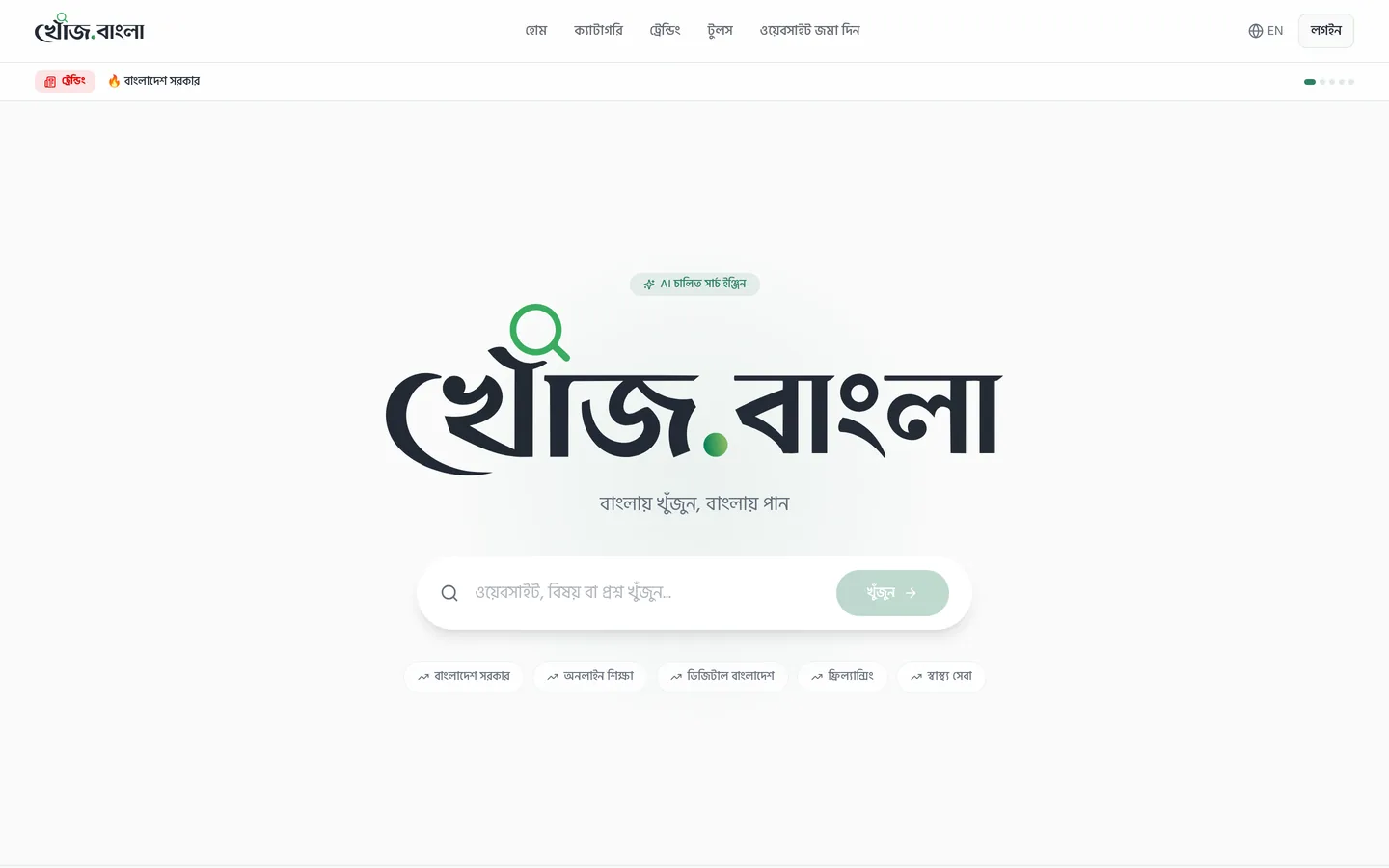
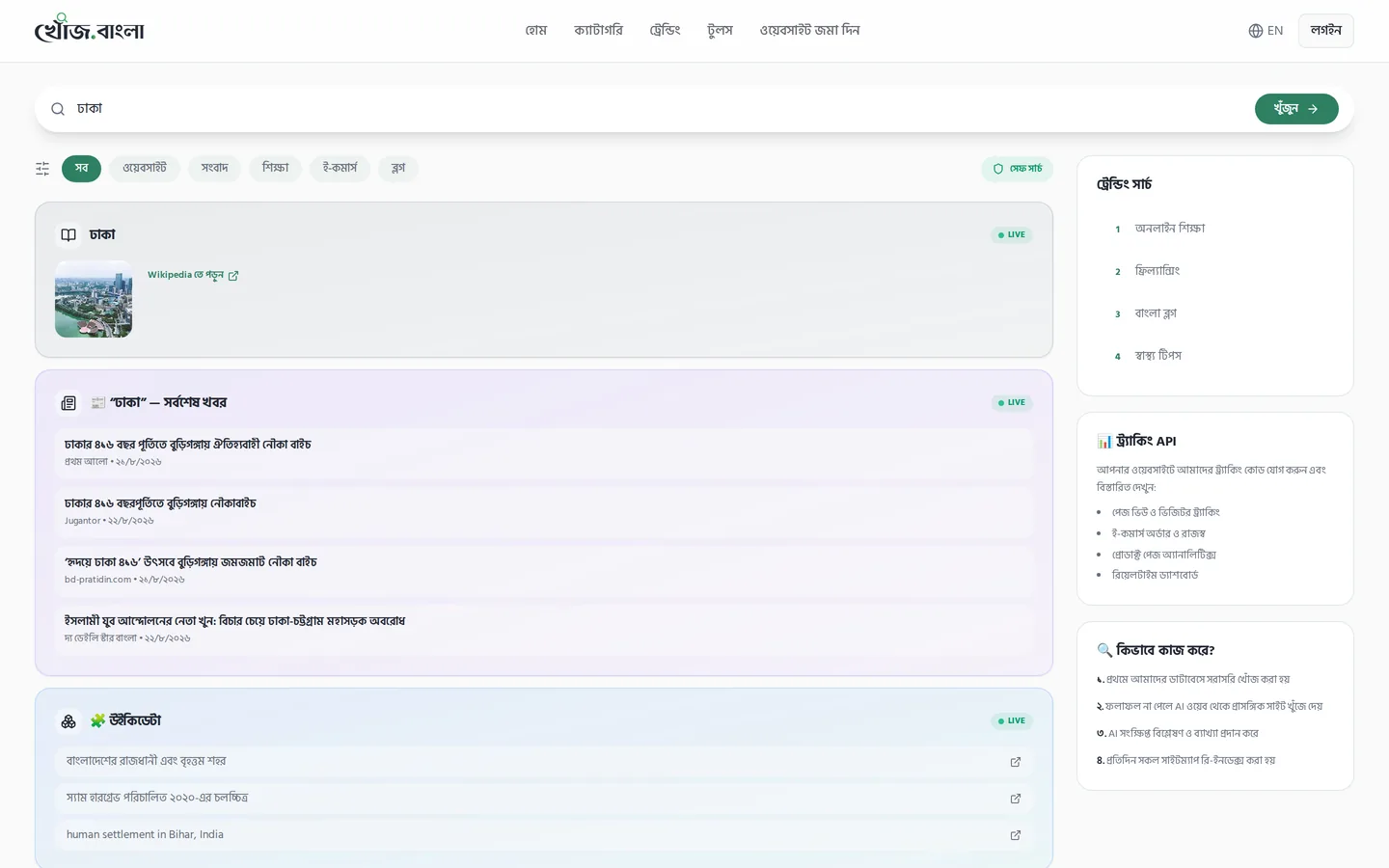
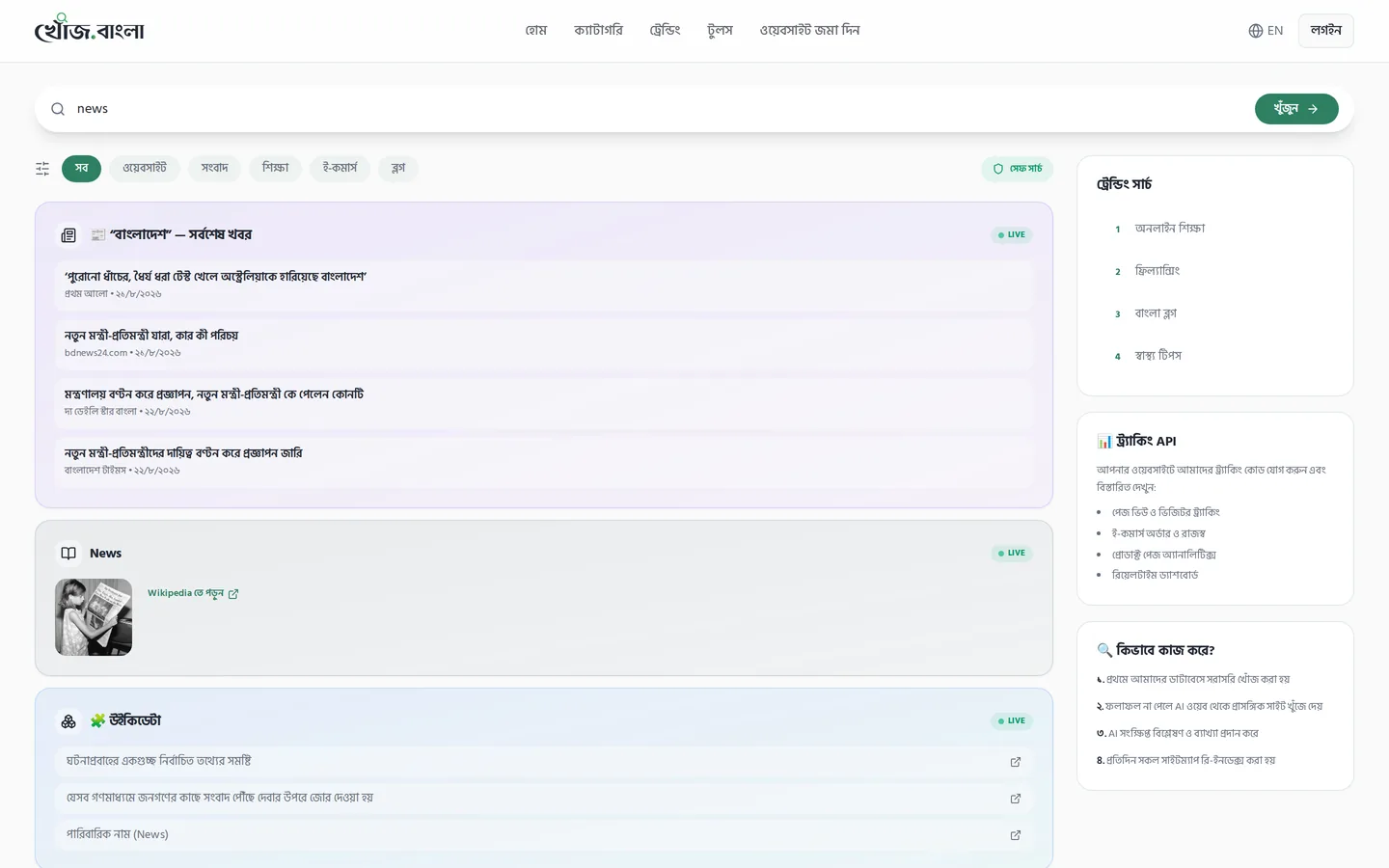
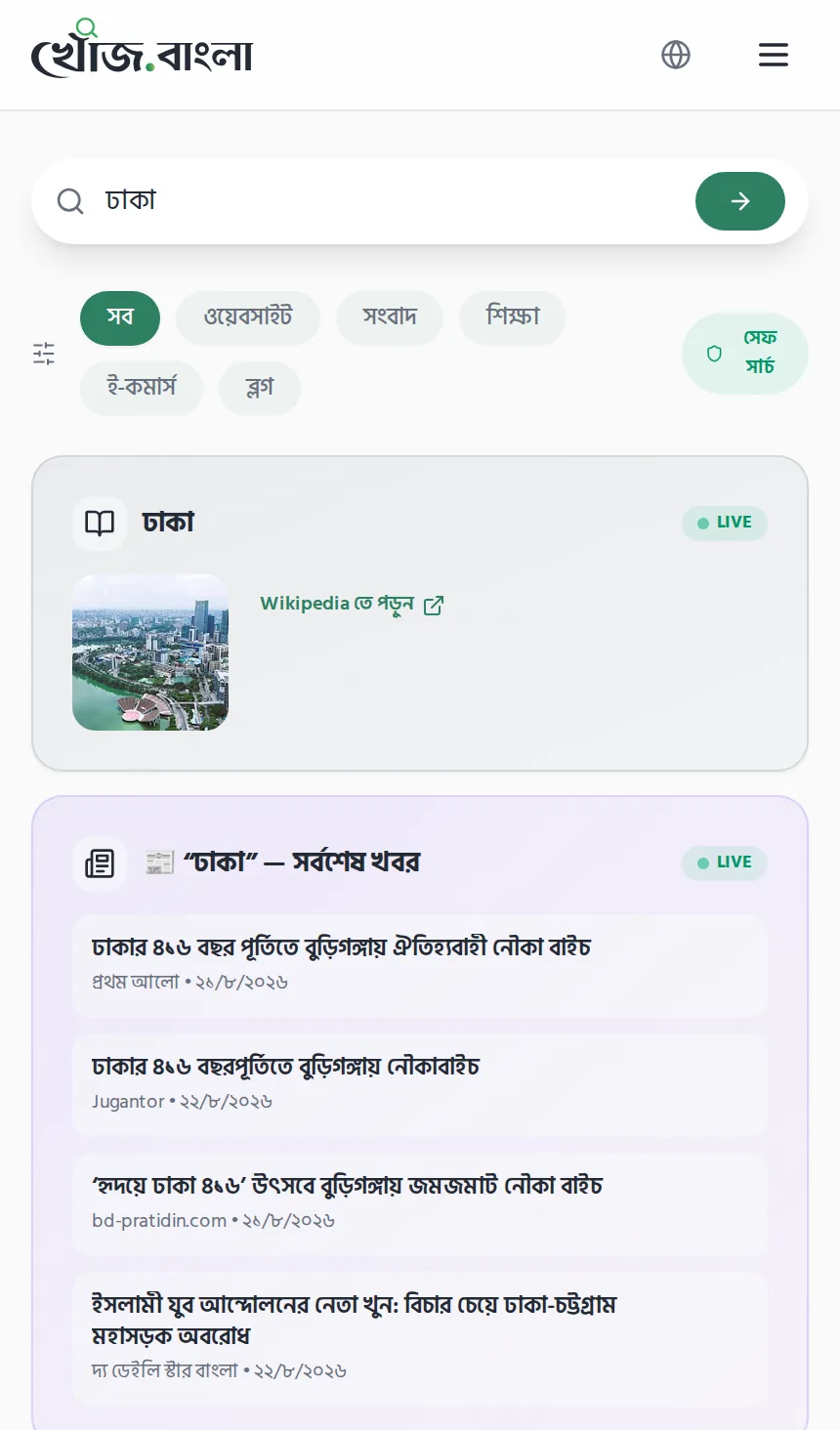
A real query, a real answer
Live screenshots captured on 22 August 2026, including a Bangla query returning Bangla sources.
Around the search box
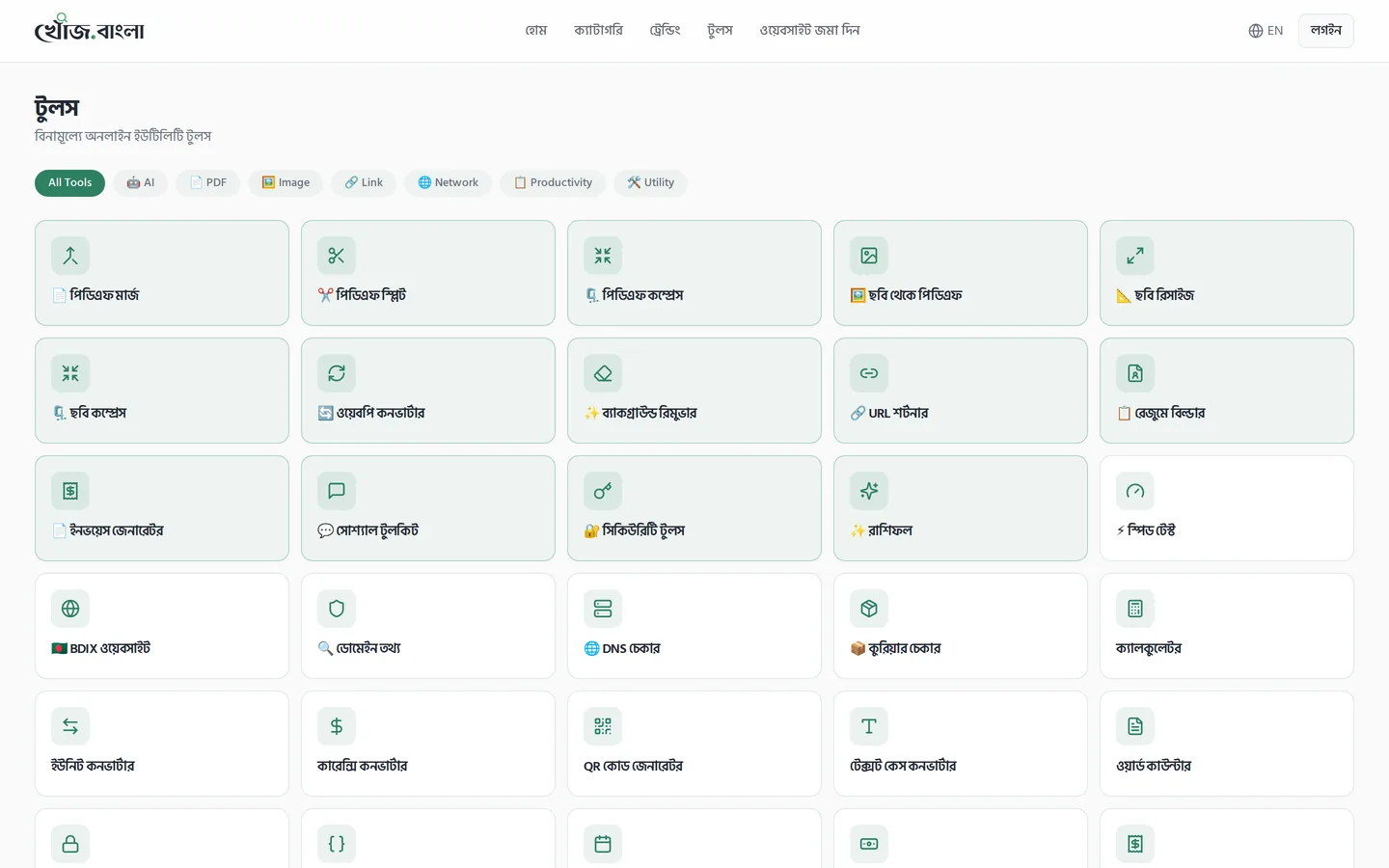
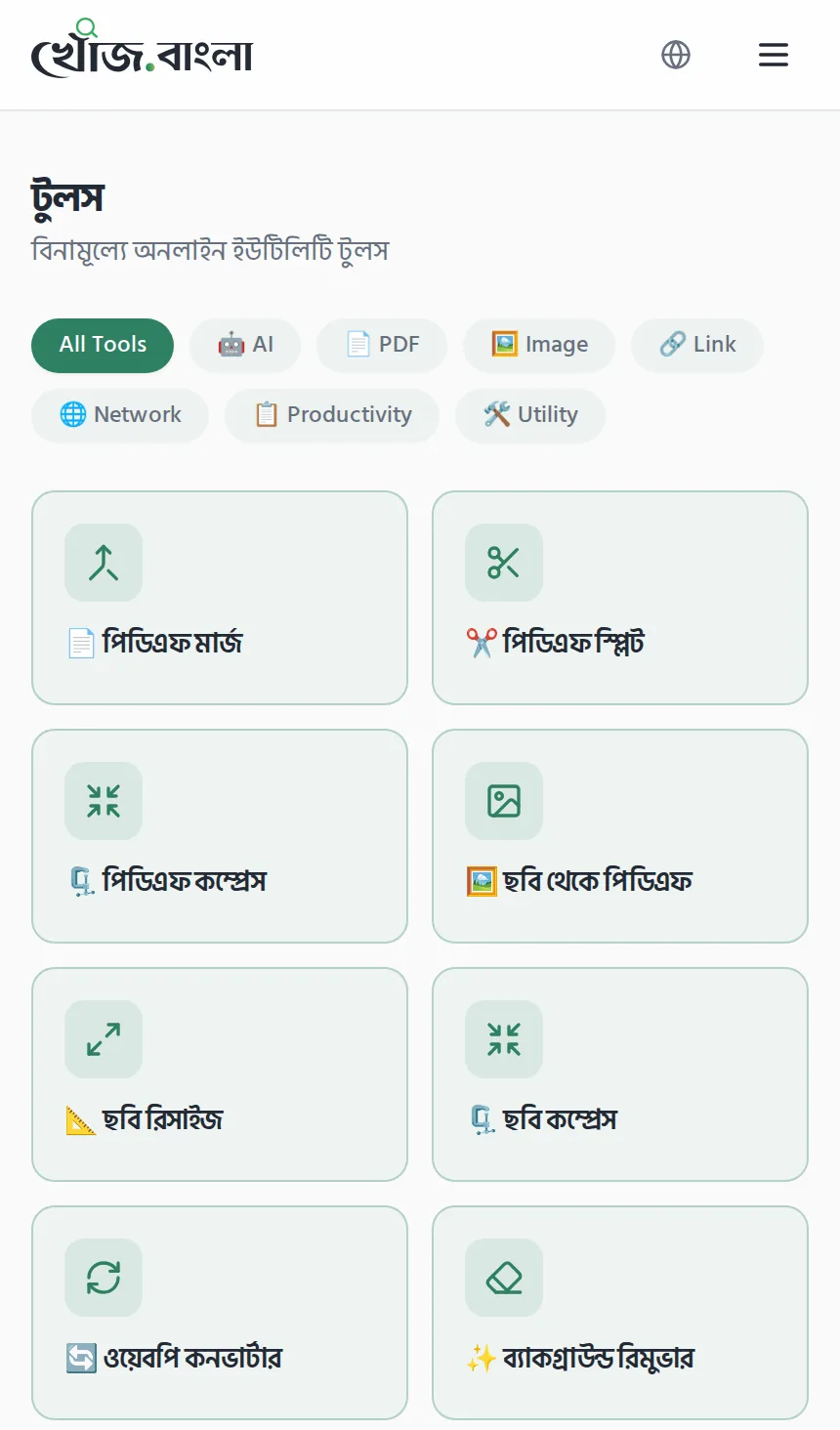
Forty-six tools, in Bangla, free
Pipilika added a library, shopping and jobs for the same reason: a search box alone gives nobody a reason to return. These are grouped the way the site groups them, and every one is labelled in Bangla.
Utility — 19 tools
Calculator, unit and currency converters, QR generator, Wi-Fi QR, text case, word counter, password generator, JSON formatter, age, EMI, VAT, percentage and BMI calculators, timestamp converter, Bangla number converter, slug generator and image search.
AI — 9 tools
Image generator, text generator, code generator, translator, summariser, chatbot and colour palette — the tools a Bangladeshi student or freelancer would otherwise pay in dollars for.
PDF — 4 tools
Merge, split, compress, and image-to-PDF. Ordinary office work, which is exactly why it is the traffic that keeps coming back.
Image — 4 tools
Resize, compress, WebP conversion and background removal.
Network — 4 tools
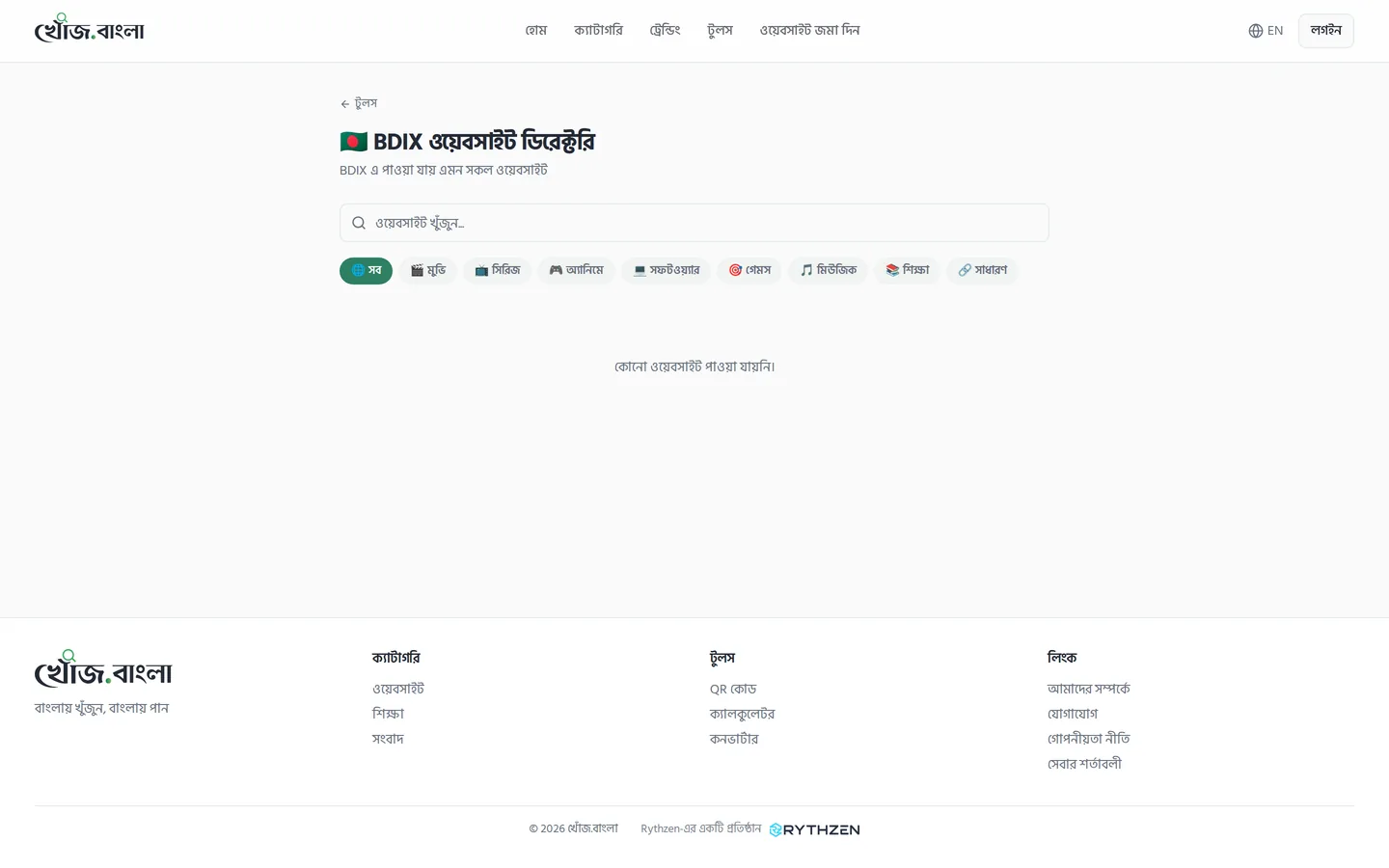
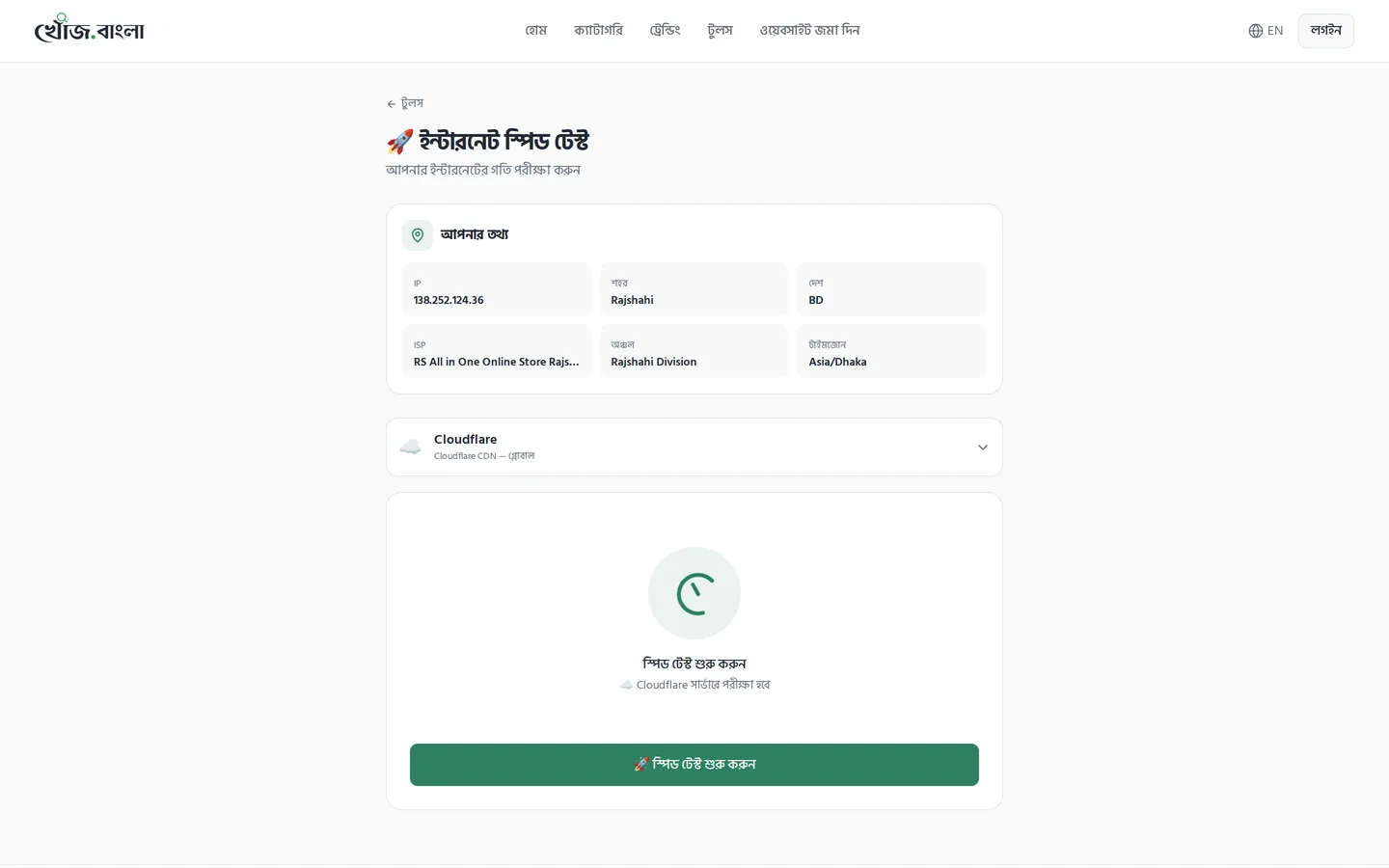
Internet speed test, a BDIX website directory, domain information and a DNS checker — built for a market where "is it inside BDIX?" is a question people genuinely ask.
Productivity — 4 tools
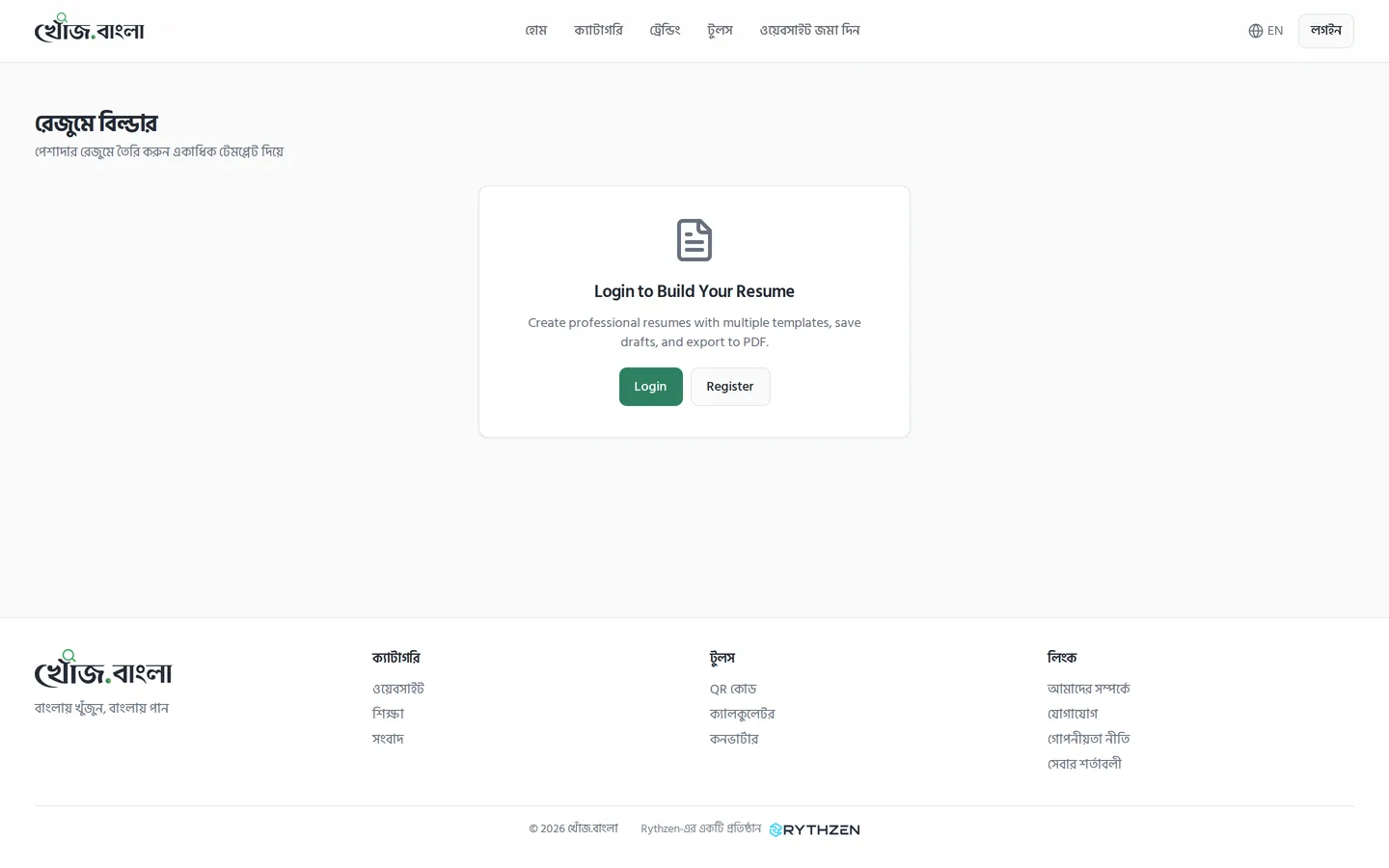
Résumé builder, invoice generator, a social toolkit and security tools, each saving its work so it can be reopened.
Bangladesh-specific
A courier tracking checker for local delivery companies and a VAT calculator matching local rates — the kind of thing a global tool site will never build.
And a link shortener
Short links with click tracking, served from the same domain.
More of the surface
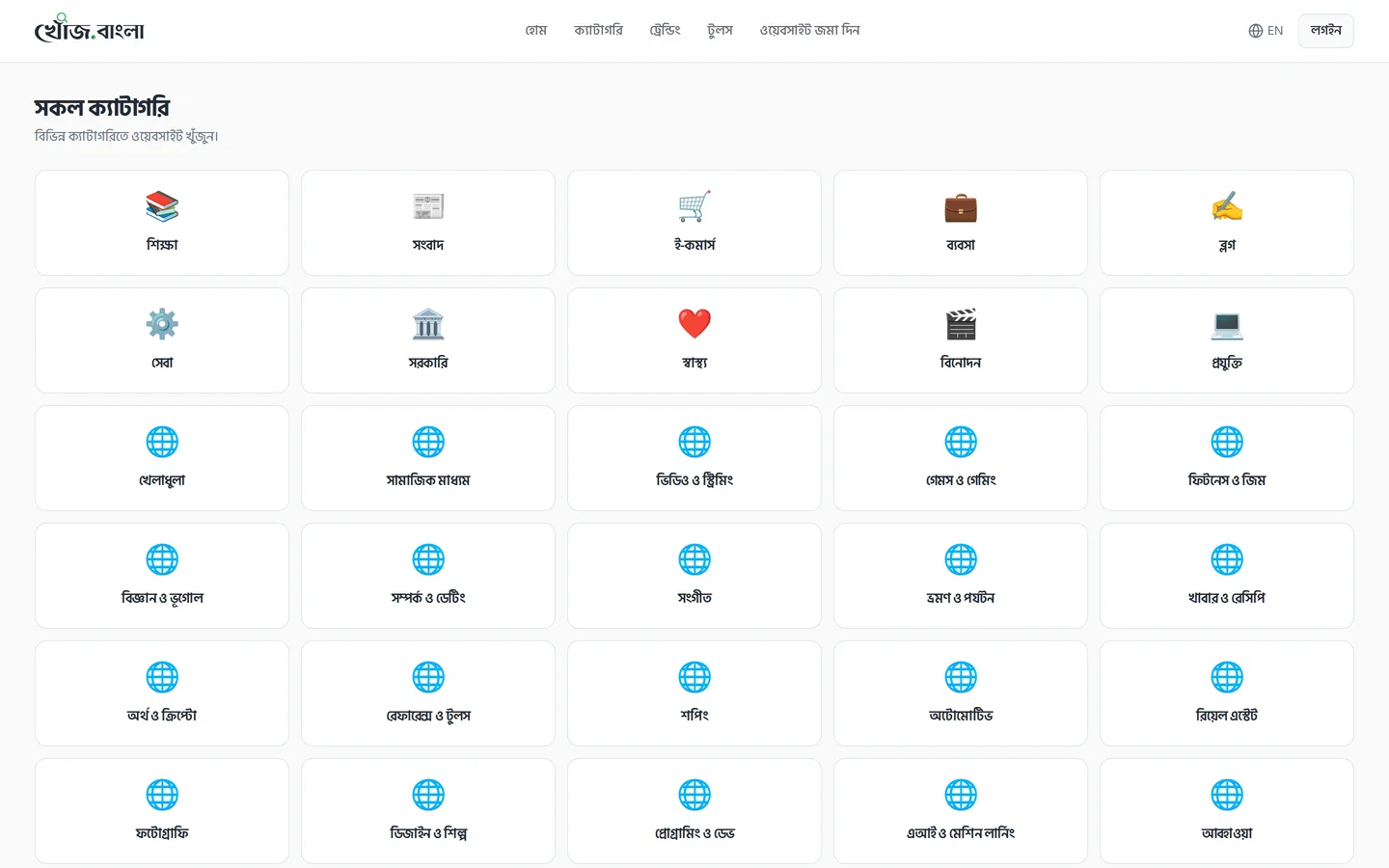
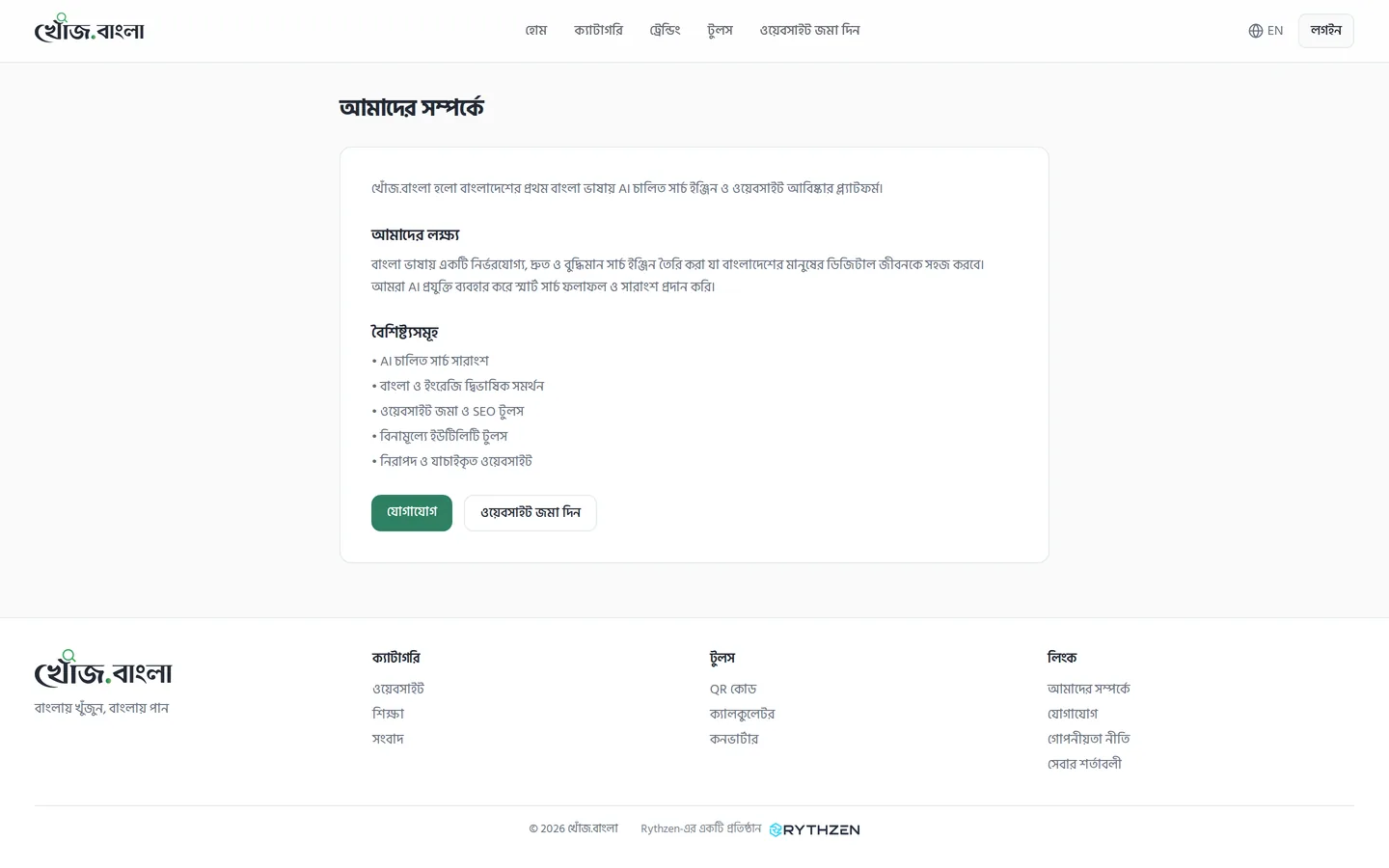
Every public page, as it is today
Captured on 22 August 2026 at 1440×900 across both domains. No mockups, no design comps, no seeded demo data.

Where it will be used
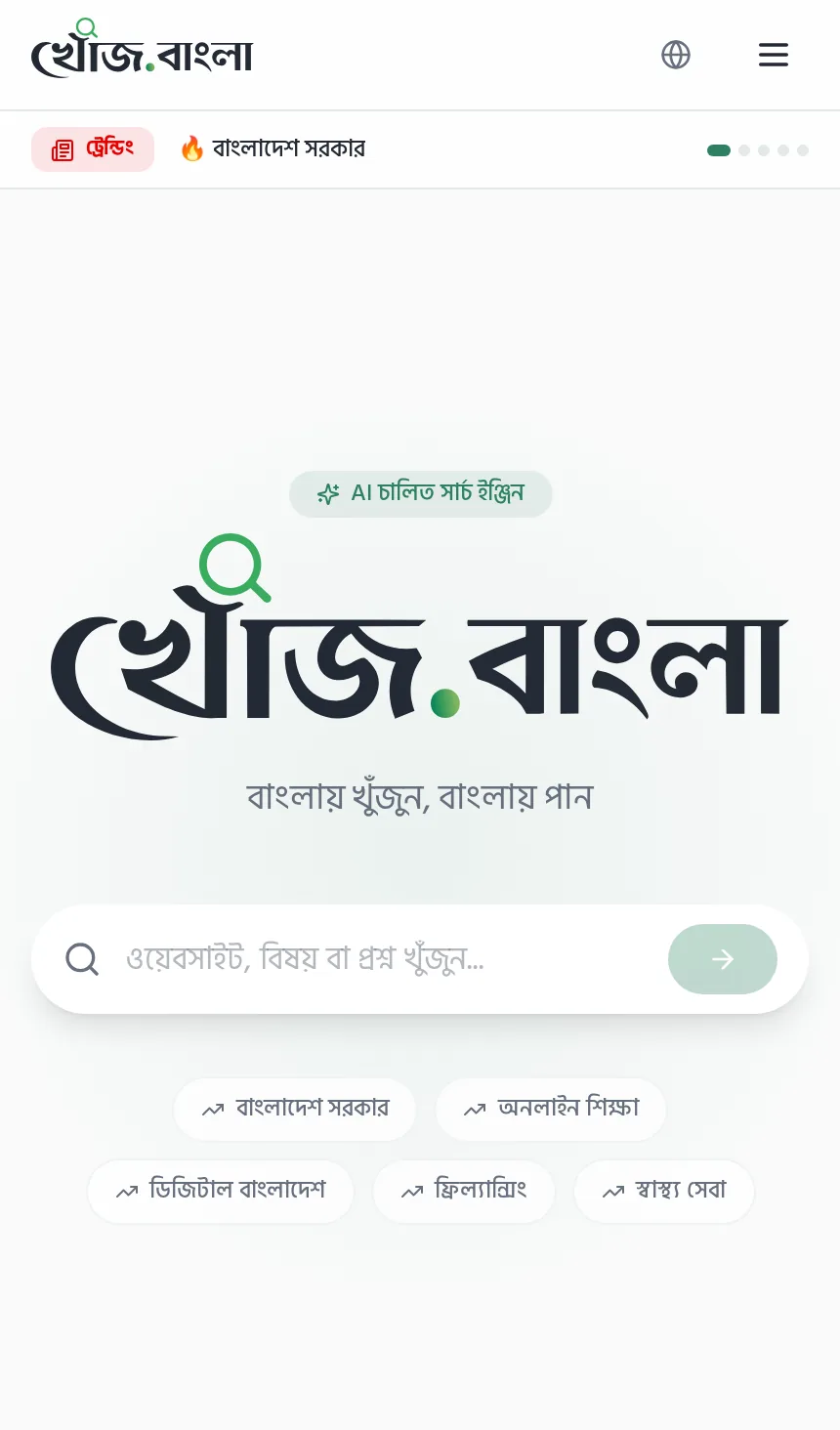
A phone, on a Bangladeshi connection
Bangladesh is the most mobile-weighted internet market measured anywhere: about 71% of web requests from the country come from a phone, ahead of Nigeria and the Philippines. Often that is on a connection where every kilobyte is a decision.
A search engine is the one page that has to be fast before anything else on the device is. So the interface is deliberately plain: one field, no carousel, no hero video, fonts self-hosted rather than fetched from a third party, and results assembled with caching in front of every external source.
The two addresses
Why there is a Bangla domain and a Latin one
Bangladesh has its own Bangla-script top-level domain. .বাংলা was applied for through ICANN's IDN fast-track process in December 2010, passed the stability review in March 2011, and was delegated in 2016 to the Ministry of Posts, Telecommunications and Information Technology, with BTCL operating it alongside .bd.
It is barely used. Most Bangladeshi businesses that could have a Bangla address run a Latin one instead, which means the country has a domain in its own script and almost nothing sitting on it. A Bangla-first search engine is exactly the kind of thing that should.
Both addresses serve the same application from the same document root — this is not a redirect trick, and neither is the "real" one.
- খোঁজ.বাংলা — the Bangla address, typeable end to end on a Bangla keyboard
- Punycode xn--54b7fta0cc, so the delegation is a real DNS entry rather than a display alias
- khojdotbangla.com — the same engine for clients, keyboards and copy-paste paths that still mangle IDNs
- One codebase, one index, one document root: no second-class version
- Canonical URLs and structured data so search engines do not treat the pair as duplicates
- Written and tested in both scripts, because a Bangla domain rendered wrongly is worse than no Bangla domain
The architecture
What is built, and what is being built
The honest position, stated plainly: the live engine answers queries from a curated index plus live open-data sources. The full web-scale search stack is specified and in progress.
Publishing that distinction matters. An index of 98 verified sites is a real, useful thing for someone looking for Bangladeshi sources. Calling it a web index would be a lie that the second query would expose.
One architectural decision is worth naming because it was a compromise: the search core runs on PostgreSQL, not OpenSearch. OpenSearch was specified, costed, and rejected for now — the box that runs it also runs the rest of the estate, and there was not enough memory to do it honestly. It is revisited when the hardware is.
- Live: Bangla and English query handling against a verified index with 231 bilingual tags
- Live: a hand-built Bengali analyser, OR-matching queries, generated search vectors, GIN and trigram indexes
- Live: a recovery ladder that rewrites and relaxes a failing query instead of returning nothing
- Live: 49 keyless data providers with fallback chains, database-backed caching and per-provider circuit breakers
- Live: 46 free tools, category browsing, trending queries, public site submission and a PWA install path
- Live: self-hosted Bangla typography and an IDN Bangla domain alongside the Latin one
- In progress: a first-party crawler with politeness rules, per-host budgets and SSRF protection
- In progress: hybrid ranking combining keyword scoring with vector similarity and reciprocal rank fusion
- In progress: authority scoring, spam suppression and autocomplete
- Planned: Common Crawl ingestion, then webmaster tooling so site owners can see their own coverage
Thirteen years of Bangladeshi search, in order
The first four entries are Pipilika's, from published sources. The rest are shipping dates for this project, not plans.
2009
Pipilika begins
A Bengali text search project starts in the CSE department at Shahjalal University of Science and Technology, supervised by Professor Muhammad Zafar Iqbal.
13 April 2013
Pipilika launches
The beta is unveiled in Dhaka — Bangladesh's first search engine, built by eleven SUST students on four terabytes, with Grameenphone IT financing and distributing it.
2016
Pipilika at its widest
News, library, shopping and job search join Bengali spelling correction and the Bengali dictionary.
2021
Pipilika goes dark
A university project with no revenue model and almost no promotion shuts down. Nothing takes its place.
July 2026
খোঁজ.বাংলা goes live
The engine launches on both the Bangla IDN and khojdotbangla.com, on a 61-table schema.
August 2026
The index gets real
98 Bangladeshi sites verified reachable and seeded; four well-known domains rejected because they do not resolve. English-to-Bangla tag search added.
August 2026
Live data rebuilt keyless
Every key-gated provider is replaced with an open one — 49 of them — behind caching and circuit breakers.
August 2026
Brand and typography locked
The owner's artwork becomes the wordmark, with Hind Siliguri self-hosted throughout.
August 2026
The tool surface
46 free Bangla tools ship around the search box, from PDF and image work to AI, BDIX lookup and a courier tracker.
Next
The crawler
A first-party crawler and hybrid ranking — the step from a curated index to a web index.
Fair questions
Is খোঁজ.বাংলা really Bangladesh's second search engine?
By any reasonable reading, yes. Pipilika, launched at SUST in April 2013, is universally described as the country's first, and it shut down in 2021. Bangladesh has had no homegrown, generally-available search engine since. There have been directories, aggregators and metasearch wrappers, but a second engine with its own index and its own ranking is what this is.
What exactly happened to Pipilika?
It shut down in 2021. The reasons its own team and the Bangladeshi press give are consistent: it was a university thesis project rather than a commercial one, so it never developed a way to pay for itself, and it had almost no promotion, so most Bangladeshis never knew it existed. It was not out-engineered — it ran out of the two things a product needs that a thesis does not.
Is this trying to replace Google?
No, and any project that says otherwise is selling something. Google holds about 97% of search in Bangladesh. The aim is to be the better answer for a narrow set of questions — Bangladeshi topics, Bangla sources, a Bangla interface, on a phone. That is a real gap and it is winnable.
Only 98 sites? That is tiny.
It is, and we would rather say so than round it up. Every one of those sites was verified reachable before it went in, which is why the engine does not return dead links. The crawler that turns a curated index into a web index is the next major piece of work, and until it lands this number stays on the page.
Can I search in English?
Yes. Indexed sites carry bilingual tags, so an English query can find a site that only describes itself in Bangla. Banglish — Bangla typed in Latin letters — is handled through a transliteration lexicon, which is how a great many Bangladeshis actually type.
Why a Bangla domain name?
Because a Bangladeshi user can type it without switching keyboards. .বাংলা is Bangladesh's own Bangla-script top-level domain, delegated in 2016 and operated by BTCL, and it is badly under-used. খোঁজ.বাংলা is a genuine IDN, not a redirect, and khojdotbangla.com serves the identical engine for clients that struggle with IDNs.
Where do the live answers come from?
Open, keyless sources — Bangla news feeds from Bangladeshi outlets, Wikipedia and Wikidata, weather services, dictionaries, currency rates and trend data. Each provider is a database row with its own fallback chain, cache and circuit breaker, so one slow source cannot hold up a page.
Why are there 46 tools on a search engine?
For the same reason Pipilika added a library, shopping and jobs. A search box alone gives nobody a reason to come back on a day they are not searching. A student who compresses a PDF here, a freelancer who builds a CV here and a shop owner who tracks a courier here are all one query away from using the search too.
Do you track what I search for?
The engine caches results to stay fast and records queries to know what to index next and what to show as trending. It is not built as an advertising product and there is no advertising network behind it to feed.
I run a Bangladeshi website. How do I get indexed?
There is a public submission route on the site with a verification step. Submitted sites are checked as genuinely reachable before they enter the index, which is why the index is small and why it does not return dead links.
Why PostgreSQL rather than a real search engine?
Honestly, capacity. OpenSearch is specified and costed, but the server that would run it also runs the rest of the estate and there was not enough memory to do it properly. Postgres with a hand-built Bengali analyser is what an index of this size actually needs, and the decision is revisited when the hardware changes rather than pretended away.
Sources
Every figure on this page about Bangladesh, the Bangla language or Pipilika comes from a named outside source. The figures about খোঁজ.বাংলা itself are read from its own live database on 22 August 2026 and are not cited here, because there is nothing to cite them to but us.
- Pipilika: launched 13 April 2013, a SUST CSE project, shut down in 2021, and why — Wikipedia, "Pipilika", retrieved 22 August 2026
- Pipilika: project supervision, Grameenphone IT backing, and the indexed sources — বাংলা উইকিপিডিয়া, "পিপীলিকা (সার্চ ইঞ্জিন)", retrieved 22 August 2026
- Pipilika: eleven SUST students, four terabytes of storage, and the Dhaka launch event — Business Inspection BD, "Why Bangladeshi Search Engine Pipilika Failed?", retrieved 22 August 2026
- Bengali is the sixth most spoken native language, ~230 million native and ~273 million total speakers — Wikipedia, "Bengali language", retrieved 22 August 2026
- Bengali accounts for less than 0.5% of web content, while English accounts for close to half — Statista, most common languages used on the internet, retrieved 22 August 2026
- Google holds roughly 97% of search engine market share in Bangladesh — StatCounter Global Stats, Search Engine Market Share Bangladesh, retrieved 22 August 2026
- Bangladesh has the world's highest share of web requests from mobile devices, around 71% — Cloudflare Radar analysis, mobile device share by country, retrieved 22 August 2026
- Bangladesh had roughly 83 million internet users at about 47% penetration — DataReportal, "Digital 2026: Bangladesh", retrieved 22 August 2026
- .বাংলা was requested through ICANN's IDN fast track in 2010–2011 and delegated in 2016; BTCL operates it — IANA, delegation report for .বাংলা, retrieved 22 August 2026
Outside figures move. Each is dated so a reader can tell how old it is rather than assuming it is current, and any of them can be checked at the link given.
Try it in Bangla
Search for a Bangladeshi topic and see what a Bangla-first engine returns. If you run a Bangladeshi site and want it indexed, there is a form for that — and if you want the tools without the search, they are free and need no account.
More from Rythzen
HostiQuro
A hosting company built for Bangladesh, in Bangla and English.
Read more →CareOS
The operating system for pediatric therapy clinics and inclusive preschools.
Read more →Yooho.me
One link for your whole professional life.
Read more →OFFICEAVO
One operating system for every office.
Read more →ReputeCheck
Know who to trust before you buy, sell, hire, or partner.
Read more →QuroPanel
Run hosting, servers and billing from one open platform.
Read more →MyOwnCloud
আপনার ডেটা সুরক্ষিত, প্রতিটি ধাপে — your data protected at every step.
Read more →Rythzen Pay
Accept payments across every Rythzen product, from one account.
Read more →Rythzen Panel
Your servers. One app. Total control.
Read more →আলোর বাণী
Word of Light — the Catholic Bible, in বাংলা.
Read more →Lojai Farmgate
ফার্মগেটের মানুষ, সেবা ও সহায়তা — একই ডিজিটাল কমিউনিটিতে।
Read more →